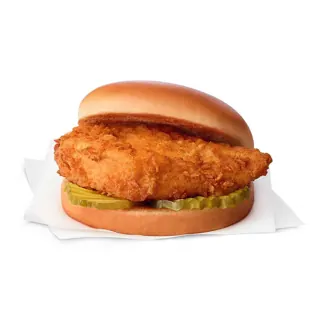
Chick-fil-A® Chicken Sandwich
This is the classic: a boneless breast seasoned, breaded and pressure cooked in peanut oil, served on a toasted buttery bun with two dill pickle chips. It is a whole breast, not a ground patty. See the card for the starting price, then read the sections below.
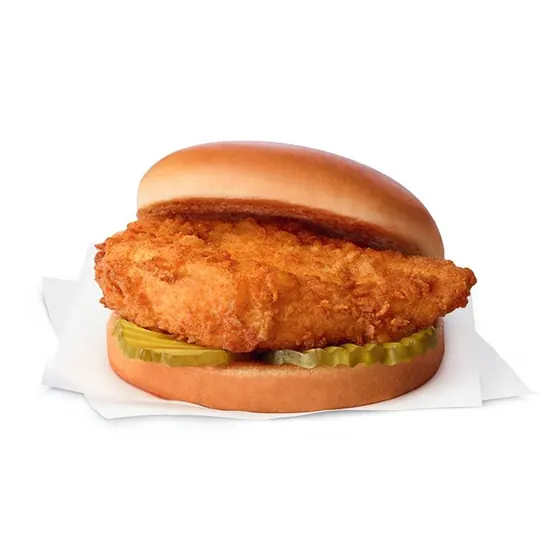
The classic build in brief
Chick-fil-A® Chicken Sandwich
People search for the chick fil a chicken burger when they want the classic sandwich: a fried boneless chicken breast, two pickles and a buttered bun. That is the original, and it has barely changed. This guide covers what is in it, how it is cooked, the bun choices, allergens, nutrition and how it differs from the spicy, deluxe and grilled versions.
The original is the plain, fried chicken sandwich that built the brand. Chick-fil-A describes it as a boneless breast of chicken seasoned to perfection, freshly breaded, pressure cooked in 100% refined peanut oil and served on a toasted, buttery bun with dill pickle chips. Nothing else goes on it.
That short build makes the chicken sandwich at Chick-fil-A easy to recognize and easy to order. You get one filet, two pickle chips and a bun. The company says the recipe has been refined over nearly 60 years, and the goal is to make it taste the same in every restaurant.
Chick-fil-A® Chicken Sandwich
On the delivery app, the sandwich starts at $7.89+. In-store prices differ by restaurant, so use that number as a guide. If you want to see where it sits among all the other items, open the full Chick-fil-A menu.
The sandwich also comes on a multigrain bun if you prefer. The rest of this page goes through each part in turn, starting with the name people keep using for it.
The word burger sticks because of the shape. A round bun, a flat piece of meat and a pickle look like a burger, so many people reach for that word. In some countries, a chicken burger is simply the normal term for any bun sandwich with chicken in it. Searchers from those places often type that phrase and land on the same sandwich.
The two things are not the same, though. A burger patty is usually ground meat shaped and pressed. Chick-fil-A uses a whole boneless breast, which is why the bite feels like real chicken rather than a molded patty.
You will also see the piece of chicken called a filet. Chick-fil-A uses that spelling on its menu, with one L and the French-style ending. It is why you will see names such as the grilled filet or the spicy filet. People searching for a chick fil a filet usually mean the plain breast, with no bun at all. Chick-fil-A sells that piece of chicken inside the sandwich, in some meals and as an add-on in a few menu items.
A fillet with two Ls is the more common spelling in recipes and grocery stores. The brand picked its own, and the difference does not change the food.
The original has only four parts, and each one has a job. Here is the build from the middle outward.
The original depends on that balance more than on any single ingredient. The chicken is salty, the pickles are sharp and the buttered bun softens everything. Take any piece out and the sandwich tastes flat.
Keep in mind that the chick fil a filet itself is lightly breaded. It is not a thick, craggy crust. The coating is thin enough that you taste the chicken first.
The default is the toasted, buttery bun. Many fried sandwiches on the Chick-fil-A menu list a multigrain bun as an option. The multigrain bun is the one the grilled sandwich uses by default. It is a brioche-style bun made with whole wheat and other grains, and it tastes nuttier and a little denser.
Chick-fil-A has also offered a gluten-free bun at an extra charge. When it launched, it was individually packaged so that customers could assemble the sandwich themselves, which kept the bun away from the shared kitchen. Where it is offered today, it can cost extra, and it is not available at every restaurant. The menu data used on this site lists it on the Spicy Deluxe, not on the original.
Here is the catch for anyone avoiding gluten. The breading on the chicken contains wheat. A gluten-free bun does not make the fried chicken gluten-free. If you need to avoid gluten, ask the restaurant what it can do and check the official allergen details before you order.
You can also ask for the bun to be toasted a certain way in some restaurants, though that depends on the team.
The original starts at $7.89+ on the delivery app, and that plus sign matters. The delivery app often adds a markup on top of in-store prices, and the amount changes with the restaurant and the city. If you order at the counter, in the drive-thru or in the Chick-fil-A One app, expect a different number.
The sandwich alone is the entree. A meal adds a medium side and a medium drink. The menu data lists the sandwich meal from $14.09+ on the delivery app.
| Order | What you get | Delivery app price |
|---|---|---|
| Sandwich only | Chicken sandwich | From $7.89+ |
| Sandwich meal | Sandwich, medium side and medium drink | From $14.09+ |
Most people choose waffle fries as the side, and you can often swap in mac and cheese or a different drink for a small difference. The waffle fries are the usual partner. Choices and charges vary by restaurant, so confirm in the app.
If you are ordering for a group, the plain sandwich is the cheapest way to feed someone. If you want a drink and a side anyway, the meal usually works out better than buying each separately.
Do not rely on any exact in-store price you read online, including this one. Open the app, pick your restaurant and look at the number shown before you pay.
According to the official Chick-fil-A page, the original sandwich has 420 calories. That makes it a moderate item by fast food standards, though the sodium is high. Here is the full set of numbers.
| Nutrient | Original sandwich |
|---|---|
| Calories | 420 |
| Total fat | 16 g |
| Saturated fat | 3.5 g |
| Sodium | 1,470 mg |
| Total carbohydrates | 41 g |
| Dietary fiber | 1 g |
| Sugars | 6 g |
| Protein | 29 g |
The protein is the good news. At 29 g, the sandwich is a solid source for a single entree. The sodium is the part to watch, because 1,470 mg is a big share of a daily limit for many adults.
Compare it with the others. The spicy sandwich has 450 calories and 1,740 mg of sodium. The Deluxe has 490 calories and 1,710 mg. The Spicy Deluxe has 540 calories and 1,890 mg. The grilled sandwich is the lightest at 390 calories and 765 mg, with 28 g of protein.
Remember that these numbers are for the sandwich alone. A medium side of fries and a sweet drink can double the total. For a bigger picture, see the nutrition and calorie guide.
The official page lists five allergens for the original sandwich: milk, egg, soy, wheat and sesame. The wheat comes from the bun and the breading. The egg is in the coating. The milk, soy and sesame come from the bun and its buttered oil.
The chicken is cooked in 100% refined peanut oil. Highly refined peanut oil is generally not treated the same way as whole peanuts, and Chick-fil-A does not list peanut among the allergens for this sandwich. Still, anyone with a peanut allergy should talk to a doctor and the restaurant before eating it. Restaurant kitchens share fryers, counters and gloves, so cross-contact can happen.
A few things follow from this list:
If you cook for someone with a serious allergy, ask the restaurant for its current ingredient statement. Recipes change, and the official page is the source to trust.
The original is easy to change, and a few small moves turn it into a different sandwich.
Using the Chick-fil-A One app helps here. It lets you set these changes in advance, so the team sees them on the ticket and you do not need to repeat yourself at the window. In the app you can also save your usual order and reorder in a few taps.
Not every change is free, and not every restaurant handles every request the same way. Extra toppings and bun swaps can add a charge, and the app shows it before you confirm.
If you do not want a bun at all, ask whether the restaurant can serve the chicken filet on its own. Availability varies.
The sauce list on the official site includes seven dipping sauces: Chick-fil-A Sauce, Barbeque, Garden Herb Ranch, Honey Mustard, Polynesian, Sweet & Spicy Sriracha and Zesty Buffalo. Mayonnaise, mustard, ketchup and hot sauce packets are available on request.
For the original, Chick-fil-A Sauce is the classic choice. Its sweet, tangy and smoky taste fits the pickles and the buttered bun. Polynesian leans sweeter and works well if you like a fruity dip. Honey Mustard is a good middle path. Garden Herb Ranch is creamy and cool, and Zesty Buffalo or Sriracha adds heat.
You can also add sides that change how the whole meal feels. Waffle fries are the standard. Mac and cheese makes it heavier and warmer. A side salad or fruit cup makes the meal lighter. When people build an order, the add-ons are often what separates a good order from a great one.
Many restaurants include sauces free, but the number per order can vary.
Choosing between the four main versions comes down to heat, toppings and how light you want the meal. Here is how the chick fil a original chicken sandwich lines up against the rest.
| Sandwich | Calories | Sodium | Breading | Toppings | Cheese | Suits |
|---|---|---|---|---|---|---|
| Original | 420 | 1,470 mg | Original seasoning | Pickles | None | Classic fans |
| Spicy | 450 | 1,740 mg | Spicy pepper blend | Pickles | None | Heat lovers |
| Deluxe | 490 | 1,710 mg | Original seasoning | Pickles, lettuce, tomato | American | A fuller sandwich |
| Grilled | 390 | 765 mg | No breading, grilled | Lettuce, tomato | None | A lighter meal |
Reviewers tend to rank the original near the top for balance. Many taste tests praise its juicy chicken and the way the buttered bun and pickles work together. The spicy version gets credit for a warm, building heat that does not overwhelm. The grilled sandwich is usually described as the healthiest but also the least exciting.
If you want to see how how the spicy sandwich differs, start with the seasoning. The pepper blend is the only change to the chicken. The grilled chicken sandwich is a different cooking method altogether, with a lemon-herb marinade and a multigrain bun.
The original is a crispy sandwich, but not a crunchy one. The thin breading gives a light crackle, and the chicken underneath stays tender. That contrast is what people mean when they praise this sandwich.
Pressure cooking is a big part of it. The sealed fryer cooks the chicken at a lower temperature than an open fryer, which holds in moisture. The breading sets without drying the meat. The result is juicy chicken in a coating that does not feel heavy.
Then there is the bun. The buttered, toasted surface adds a soft richness against the salty chicken. The pickles cut it with acid. Together, the sandwich tastes salty, a little sweet and tangy in the same bite.
Copycat recipes get close but rarely match it. Home cooks cannot easily reproduce a commercial pressure fryer, and the exact seasoning is not public. A good copy is still worth trying, but the real sandwich is more consistent.
You can make a decent version at home, and many cooks try. A common approach is to marinate chicken breast pieces in pickle brine, coat them in seasoned flour and fry them in peanut oil, then serve them on a buttered, toasted bun with two pickle chips.
The hard part is the pressure fry. Home kitchens use open pots or air fryers, which change the texture. The breading may come out thicker or drier. Peanut oil helps with flavor and a high smoke point, but it is not the whole story.
Think of a home version as a tribute, not a clone. It is fun and it often tastes great. If you want the exact thing, the restaurant is still the only place to get it, and the price is modest compared with the time spent cooking.
Chick-fil-A has run limited-time sandwiches that add pimento cheese or a honey pepper sauce to the fried chicken. These come and go, and some years they do not appear at all. If one is listed, treat it as a seasonal extra rather than part of the standard lineup. It starts from the same filet and bun, then changes the toppings. Availability varies by restaurant, so check the app first.
It has a boneless breast of chicken that is seasoned, freshly breaded and pressure cooked in 100% refined peanut oil. It is served on a toasted, buttery bun with dill pickle chips. Nothing else comes on it unless you add it, such as cheese, lettuce or tomato, or a different bun.
Yes. The chick fil a crispy chicken sandwich is breaded and pressure cooked in 100% refined peanut oil, which is a type of deep frying in a sealed fryer. The grilled sandwich is the exception, because it is marinated and grilled with no breading.
The official Chick-fil-A page lists 420 calories. It also lists 16 g of fat, 1,470 mg of sodium, 41 g of carbohydrates and 29 g of protein. Sauces, cheese and a different bun change the totals, and the side and drink add more.
Chick-fil-A cooks its fried chicken in 100% refined peanut oil. People with a peanut allergy should speak with a doctor and the restaurant before ordering, because kitchens share equipment and cross-contact can happen.
Yes. The original comes with two dill pickle chips on the chicken. You can ask for no pickles if you dislike them, or ask for extra if you want more tang. The Deluxe version keeps the pickles and adds lettuce, tomato and cheese.
Multigrain is listed as an option on the original. A gluten-free bun has been offered at an extra cost at some restaurants, but it is not guaranteed everywhere. Even with that bun, the breaded chicken still contains wheat, so it will not be gluten-free.
No. The bun and the breading both contain wheat. A gluten-free bun replaces only the bun, so the sandwich still has gluten in the coating. The grilled sandwich has no breading, but its multigrain bun contains wheat too.
The official page lists milk, egg, soy, wheat and sesame. The chicken is also cooked in refined peanut oil. Adding cheese, sauces or a different bun can add more allergens, so check the current ingredient details before ordering.
On the delivery app, the sandwich starts at $7.89+ and the sandwich meal starts at $14.09+. The meal adds a medium side and a medium drink. In-store prices differ and vary by restaurant, so the chick fil a original chicken sandwich often costs less at the counter.
The spicy sandwich uses a spicy pepper blend in the seasoning, and everything else matches the original. It has 450 calories and 1,740 mg of sodium, compared with 420 calories and 1,470 mg for the original. Both are fried in refined peanut oil.
Yes, in practice. People who say burger usually mean the original chicken sandwich, since Chick-fil-A does not sell an item called a burger. The word is just a common name for a chicken sandwich on a bun.
Chick-fil-A Sauce is the most popular pick, thanks to its sweet, tangy and smoky taste. Polynesian is a sweeter alternative, and Honey Mustard sits in between. Garden Herb Ranch is creamy, while Zesty Buffalo and Sriracha add heat.
No. Chick-fil-A restaurants are closed on Sundays, a policy that founder S. Truett Cathy began in 1946 so employees could rest and spend time with family. If you want the sandwich, plan for another day of the week.